

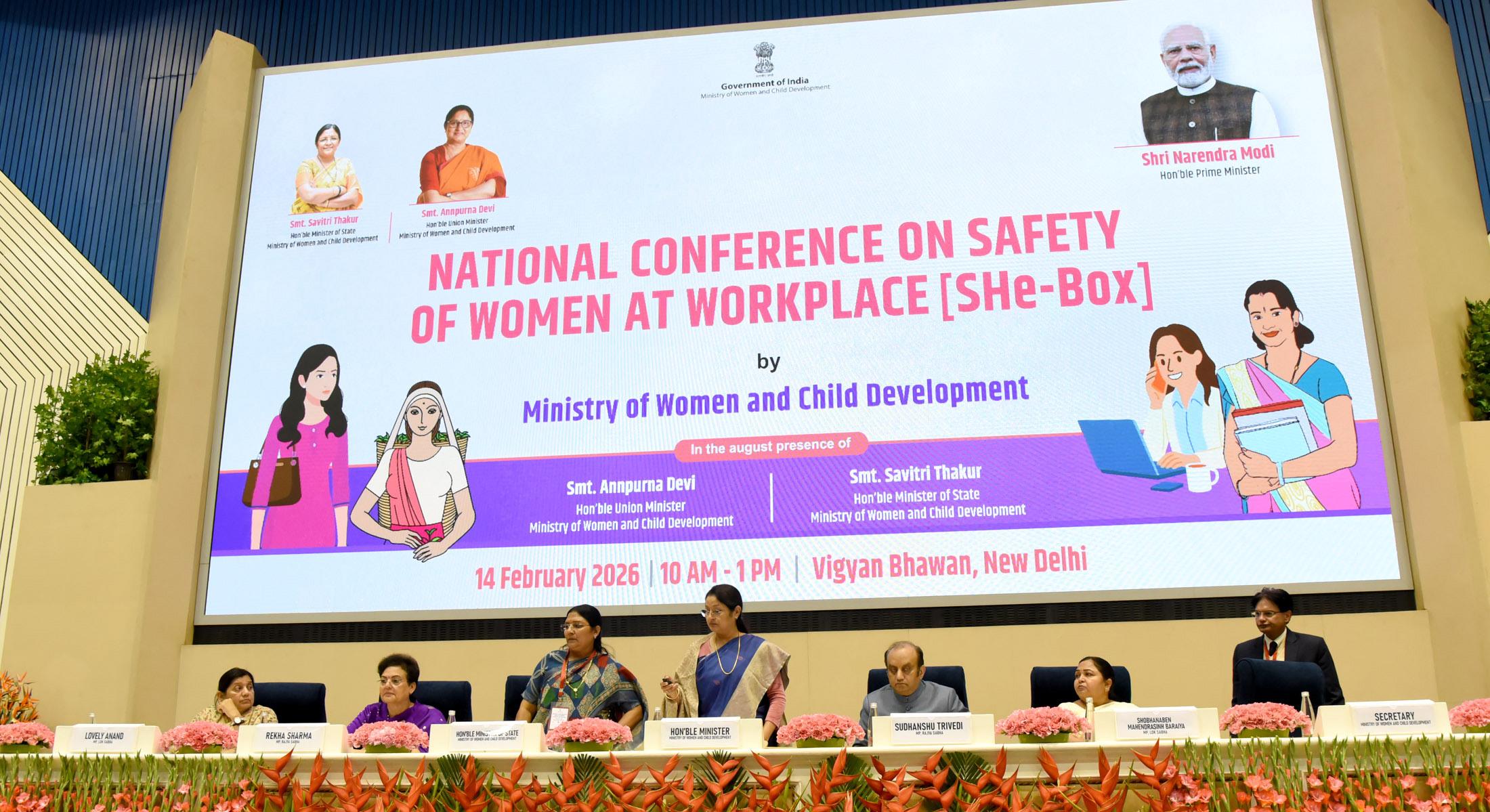
India Holds National Summit on Women and Child Development, Focuses on Women’s Safety and Empowerment

India Holds National Summit on Women and Child Development, Focuses on Women’s Safety and Empowerment
The Government of India has convened a two-day National Departmental Summit on Women and Child Development to strengthen coordination between the Centre and states on women’s empowerment, women’s safety, child protection, nutrition and early childhood education.
Held on October 8 and 9 at Sushma Swaraj Bhawan in New Delhi, the summit brought together ministers and senior officials from states and Union Territories to discuss implementation challenges, exchange successful practices and identify ways to improve the delivery of government programmes.
Organised by the Ministry of Women and Child Development, the summit forms part of a broader effort to strengthen cooperative federalism and improve coordination across government departments. The discussions focused on translating policy priorities into more effective services for women, children and families.
Four Key Priorities for Women and Child Development
The summit centred on four major areas: improving Anganwadi services, strengthening protection systems for vulnerable children, enhancing women’s safety and improving the outcomes of programmes designed to empower women.
Discussions on Anganwadi Centres addressed nutrition services, take-home rations, hot cooked meals, early childhood care and education, and the quality of data maintained through the Poshan Tracker system.
Participants also examined child protection challenges, including concerns associated with social media, alongside ways to improve institutional responses and coordination among relevant authorities.
Women’s safety and empowerment formed an important part of the agenda, with officials discussing implementation challenges and ways to improve the effectiveness of existing policies and schemes.
Prime Minister Highlights Women’s Safety and Community Participation
Prime Minister Narendra Modi chaired the summit’s valedictory session on October 9, emphasising the importance of coordinated action, community participation and more effective implementation of government programmes.
On women’s safety, the Prime Minister highlighted preventive action through greater coordination among government departments. Such an approach can help connect awareness, prevention, institutional support and public services rather than relying exclusively on responses after incidents occur.
He also suggested developing age-appropriate educational modules to promote women’s safety, dignity and empowerment among children. Early education on respect, equality and responsible behaviour can contribute to building safer and more inclusive communities.
The discussions further highlighted the importance of adolescent girls’ health, nutrition and overall development as part of a comprehensive approach to women’s empowerment.
Anganwadi Centres as Platforms for Community Development
Another key focus was strengthening Anganwadi Centres as community-level institutions supporting children’s nutrition, early learning and family welfare.
The Prime Minister suggested that universities could adopt nearby Anganwadi Centres and undertake social-impact studies. Medical students, National Service Scheme volunteers and National Cadet Corps volunteers could also be associated with community initiatives.
Such partnerships could help connect educational institutions with local development needs while encouraging students to contribute to nutrition awareness, early education and community engagement.
Improving Anganwadi infrastructure, service delivery and community participation remains important because these centres play a significant role in supporting young children and families, particularly in underserved communities.
Promoting Women’s Economic Empowerment
The summit also highlighted opportunities to strengthen women’s economic participation through existing government initiatives, community institutions and locally produced goods.
The Prime Minister called for promoting initiatives such as Vocal for Local and the One District One Product programme to support women’s collectives and local enterprises. These initiatives can provide opportunities for women-led businesses and self-help groups to improve product visibility, reach new customers and develop more sustainable sources of income.
For women entrepreneurs, access to markets is an important complement to access to finance and business training. Better connections with retailers, digital marketplaces and local supply chains can help small enterprises expand beyond their immediate communities.
The emphasis on women’s collectives also reflects the potential of group-based enterprise models to strengthen livelihoods, encourage entrepreneurship and increase women’s participation in local economic development.
Strengthening Coordination Between the Centre and States
The summit provided a platform for central and state governments to share experiences, identify implementation gaps and discuss time-bound action on key priorities.
Coordination between departments is particularly relevant to women’s safety, where prevention, support services and institutional responses may involve several agencies. Similarly, improving nutrition and early childhood development requires cooperation among health, education, nutrition and community-level institutions.
The summit’s approach seeks to encourage greater accountability for implementation while enabling states to share practices that may be adapted to local requirements.
The Road Ahead for Women’s Empowerment in India
The summit reinforces the importance of viewing women’s empowerment as a broad development priority encompassing safety, education, health, economic independence and participation in community life.
While policy discussions and government initiatives establish an important framework, their long-term impact will depend on effective implementation, accessible services, adequate resources and measurable improvements in the lives of women and children.
For women across India, stronger coordination between governments and local institutions could improve access to support systems, create opportunities for entrepreneurship and strengthen awareness of safety and equality.
The next step will be translating the summit’s recommendations into practical action at the state and community levels. Continued monitoring, public awareness and cooperation among institutions will be essential to ensuring that the priorities discussed in New Delhi lead to meaningful outcomes.
Official reference: The Ministry of Women and Child Development and the Prime Minister’s Office have published announcements and updates on the summit and its key recommendations.
Comments are closed, but trackbacks and pingbacks are open.