

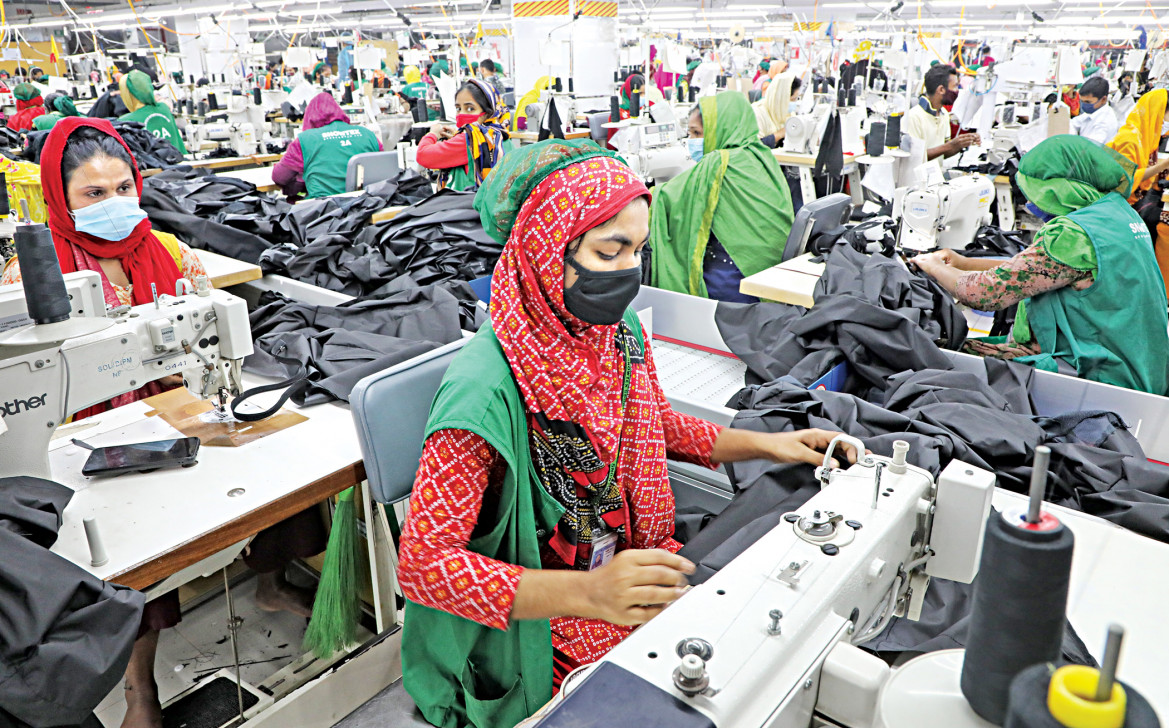

February exports hit another milestone
Earnings from merchandise shipments continued to soar in February, registering a growth of 34.54 percent year-on-year to reach $4.29 billion on the back of increased garment exports. February’s earnings were the highest in the same month of the past 10 years.
The February receipts are also 18.80 percent higher than the target of $3.61 billion. In February last year, Bangladesh recorded merchandise shipments amounting to $3.19 billion, according to data from the Export Promotion Bureau.
In January this year, earnings from merchandise shipments stood at $4.85 billion, the second-highest single-month receipts. In December, exporters raked in $4.9 billion, an all-time high for single-month earnings. Meanwhile, the takings were $4.16 billion in September, $4.72 billion in October, and $4.04 billion in November.
Between July and February, the first eight months of the current fiscal year, receipts from merchandise shipments grew 30.86 percent to $33.84 billion. The July-February earnings are also 16.5 percent higher than the target of $29.05 billion. During the July-February period in fiscal 2020-21, the total earnings were $25.86 billion.
As usual, the garment sector contributed the highest in the period. Garment exports grew 30.73 percent to $27.49 billion between July and February. Receipts from garment shipments stood at $23.47 billion in the same period of fiscal 2020-21.
Of the amount earned by garments in the July-February period this year, knitwear fetched $15.06 billion by registering a growth of 32.87 percent year-on-year. At the same time, earnings from woven items grew by 28.23 percent year-on-year to reach $12.42 billion.
“We are hopeful that the buoyance in garment exports will continue to grow as we have already booked an increased volume of work orders from international retailers and brands,” said Faruque Hassan, president of Bangladesh Garment Manufacturers and Exporters Association.
The unit price for garment items has increased though as the price of raw materials rose in international markets. “We are concerned about the Russia and Ukraine war as both countries are emerging markets for us. If the war stops, our exports to the two countries will grow rapidly,” he said.
However, local garment makers are worried about getting payments from Russian buyers as there is a ban on using SWIFT in the country. The Society for Worldwide Interbank Financial Telecommunication, or SWIFT, is a Belgian cooperative society providing services related to the execution of financial transactions and payments between banks worldwide.
“But we have more work orders. We are trying to increase the prices for our buyers. No buyers asked anything regarding the European markets as a business is continuing as usual,” Hassan said.
“Rather, we have asked the EU for an extension on the tariff benefits for Bangladesh even after the country’s LDC graduation. We got a favourable reply from the EU. Our Asian markets are also showing great promise for garment items,” he added.
In July-February, textile exports grew 35.98 percent to $993.76 million while leather and leather goods shipments increased 29.61 percent to 784.98 million.
Between July and February, earnings from frozen and live fish exports grew 20.44 percent to $407.1 million, agricultural products 28.36 percent to $853.2 million, and pharmaceuticals 21.28 percent to $130.57 million.
Non-leather footwear exports were up 32.74 percent to $290.48 million, cotton yarn and fabrics grew 45.49 percent to $150.22 million, and terry towel edged up by 19.39 percent to $31.28 million.
However, jute and jute goods, a promising export item, did not fare well as shipments declined 7.34 percent to $799.42 million during the eight-month period.
#February #merchandise shipments #eight-month period #export