

One Question from a Visually Impaired Student Inspired a ₹6 Lakh Award-Winning Innovation
One Question from a Visually Impaired Student Inspired a ₹6 Lakh Award-Winning Innovation
From One Question to a ₹6 Lakh Award: How Himaja Lingampalli Reimagined Braille Writing
A simple question from a visually impaired student changed the direction of an engineering project and eventually helped a young innovator develop an award-winning assistive technology.
Himaja Lingampalli, a fourth-year BTech student at Sri Vishnu Engineering College for Women, was visiting a school for visually impaired children near her college when she noticed the challenges students faced while writing Braille.
Using traditional Braille slates and styluses, students had to apply considerable pressure to create the raised dots on paper. Once the writing was completed, the sheet had to be turned over so the Braille could be read through touch.
For Himaja, the experience raised an important question: Could technology make Braille writing simpler, more comfortable and accessible for students with visual impairments?
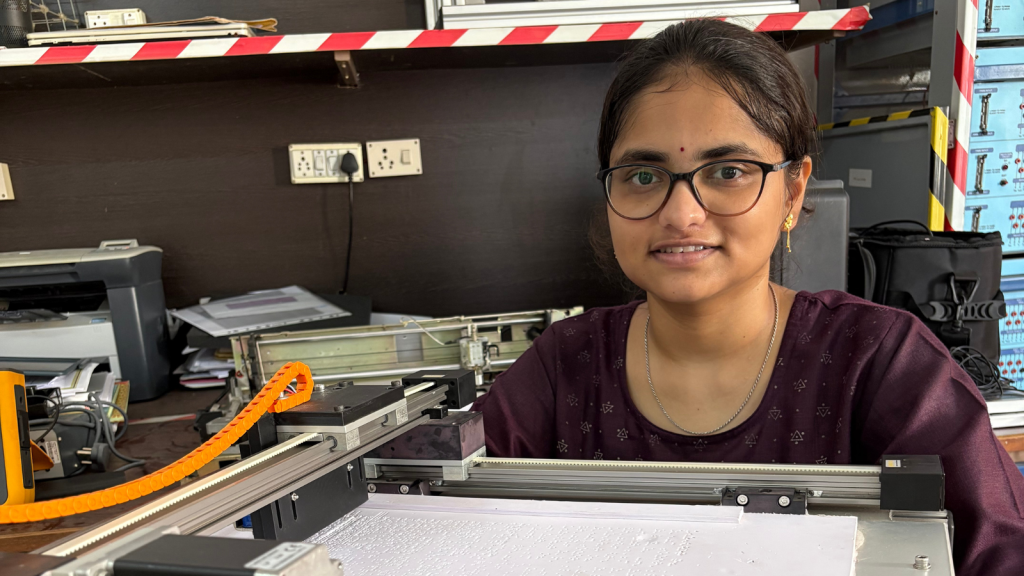
That question became the starting point for Rudhra, a voice-enabled Braille printing system designed to convert spoken words into Braille.
The innovation has now won the 2026 India National James Dyson Award, along with a prize of ₹6 lakh, and Himaja will go on to represent India at the international stage of the competition.
A Visit That Sparked an Idea
Himaja’s initial idea focused on reducing the physical effort involved in creating Braille.
Her first prototype was relatively simple. Students could use push buttons to select the six dots that form individual Braille characters. She then took the prototype back to the school to test it with students and gather their feedback.
But during one of these interactions, a student asked her a question that changed the project completely.
“Akka, why can’t we just speak instead of pressing these buttons?”
The suggestion prompted Himaja to rethink her approach.
Instead of requiring users to operate multiple buttons, she began exploring voice-based input. She eventually incorporated voice technology using Alexa, transforming the original button-operated prototype into a voice-enabled Braille printing system.
Turning Speech Into Braille
Rudhra is designed to convert spoken words into corresponding Braille characters and print them as tactile patterns.
The concept aims to simplify the process by reducing the need for users to manually select individual Braille dots. It also allows the printed characters to be experienced directly through touch.
For Himaja, the development process demonstrated the value of designing technology around the actual experiences of its intended users.
Rather than relying only on theoretical assumptions, she repeatedly tested the prototype and incorporated feedback from visually impaired students into its development.
Why She Named It ‘Rudhra’
The name Rudhra is inspired by Lord Shiva, particularly the traditional symbolism associated with the third eye.
Himaja explains that the third eye represents wisdom, higher knowledge and the ability to perceive beyond ordinary vision. She sees a similar idea in her project, which is intended to create an alternative pathway to information for people who cannot rely on conventional sight.
By converting spoken information into Braille, Rudhra seeks to make knowledge accessible through touch.
Two Years of Research and Experimentation
Developing Rudhra was not an overnight process. Himaja worked on the project for approximately one-and-a-half to two years, with support from her college faculty.
The journey involved research, experimentation, repeated trials and errors, as well as continuous feedback from users.
Her engineering education also played an important role.
Concepts from subjects such as engineering drawing, power electronics, embedded systems and sensors contributed to the development of the machine. The project also encouraged her to learn about microprocessors before they were formally introduced in her academic curriculum.
One of her biggest lessons, however, came from outside the classroom.
For Himaja, practical interaction with users demonstrated that real-world feedback can reveal possibilities that textbooks and conventional classroom learning may not provide.
Can Rudhra Become More Affordable?
The current prototype reportedly cost approximately ₹1.5 lakh to build. Himaja says the cost was influenced by the use of heavy metal and other standard components required to make the machine stable and efficient.
However, she believes the cost could be reduced substantially if the device is redesigned specifically for student use.
With alternative materials and a more compact design, she estimates that the eventual cost could potentially come down to around ₹50,000–₹60,000.
The current version uses a stationary sheet while the printer head moves along the X and Y axes.
Himaja is now exploring ways to make Rudhra smaller, lighter and easier to transport. One possibility involves keeping the printer head stationary while allowing the paper to move, which could help reduce the overall size and weight of the machine.
For now, her priority is to understand how the technology can best serve students and organisations rather than immediately turning it into a commercial product.
Designing With Users, Not Just for Users
One of the most significant aspects of Himaja’s journey has been the role played by users in shaping the innovation.
The question from a student did not simply improve an existing feature—it changed the fundamental direction of the project.
That experience highlights an important principle in assistive technology: solutions can become more meaningful when the people who will actually use them are directly involved in the development process.
For Rudhra, feedback from visually impaired students helped move the project from a mechanical button-based system toward a voice-enabled solution.
Beyond Engineering
Himaja’s interests extend well beyond technology.
She has trained in Kuchipudi, the classical Indian dance form, and has received recognition for her performances. She later developed an interest in guitar and has performed at college cultural programmes as well as outside the institution.
Alongside academics and her engineering project, she has also taken on responsibilities as a class representative and participated in sports and other activities.
Her journey reflects a combination of technical education, creativity and a willingness to explore interests beyond the classroom.
A Message for Young Innovators
For Himaja, the journey of developing Rudhra has been as much about learning as it has been about creating a device.
Her experience shows how an everyday observation, combined with curiosity and persistence, can develop into a technology with the potential to address a real-world challenge.
Her advice to fellow engineering students is straightforward: follow what genuinely interests you, remain committed to the work and keep pushing yourself to create something meaningful.
Rudhra began with a question from a student. Today, that question has helped shape an award-winning innovation—and opened the door for Himaja Lingampalli to take her idea from a college project to an international platform.
Comments are closed, but trackbacks and pingbacks are open.